Example timelines
Open an example to edit it. Your existing timelines stay in your browser library, and you can download each figure as an SVG or save its editable project to change the dates and citations in Passages.
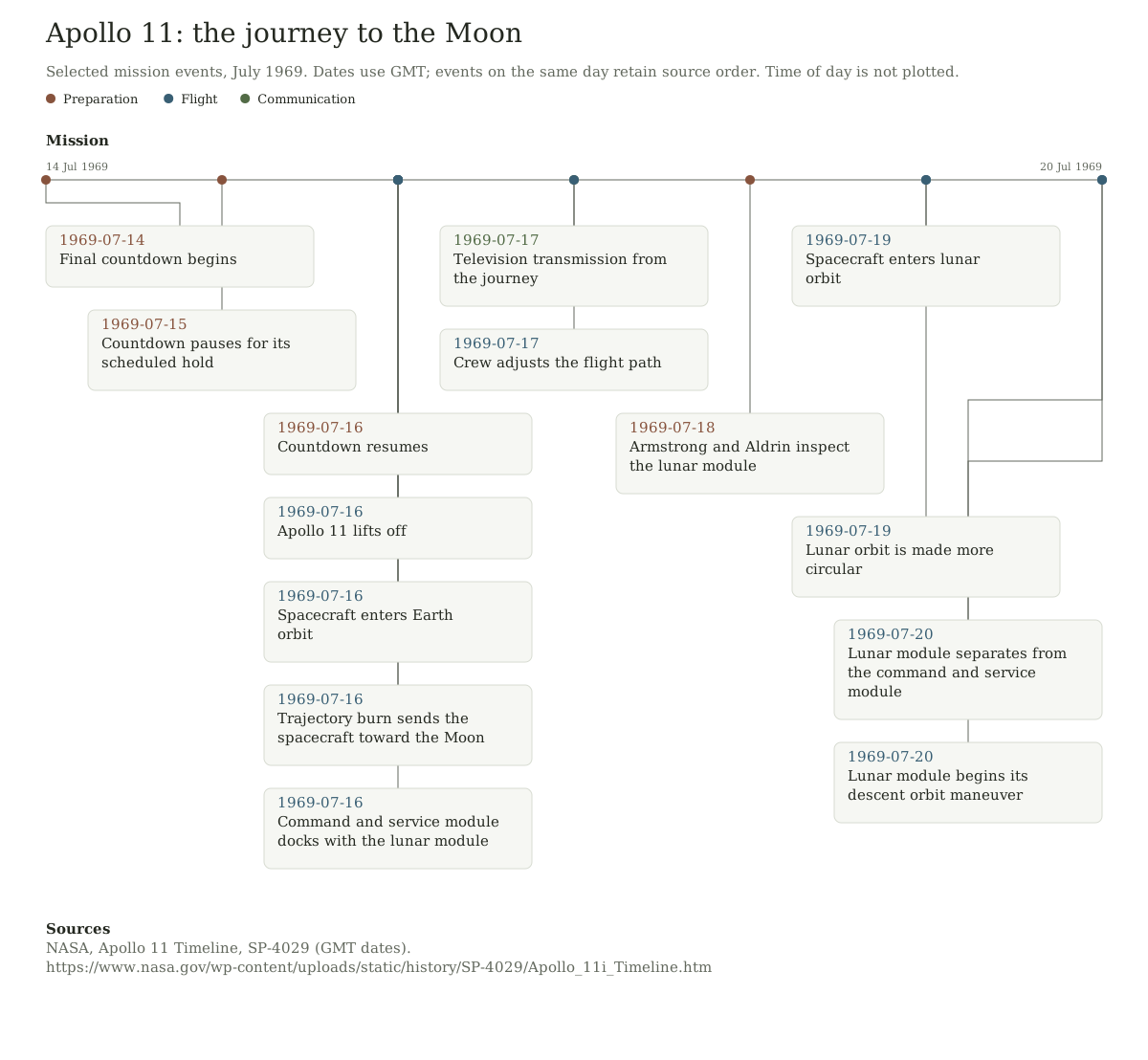
Apollo 11: a sourced timeline
Fourteen mission events, July 14–20, 1969. Several events share a date; their cards occupy separate rows while their connectors return to the same position on the date axis.
Sources and scope
Dates follow NASA’s Apollo 11 timeline, SP-4029. This selection ends before the lunar landing. Dates use GMT, and events on the same day retain source order. Time of day is not plotted.
A figure for a slide
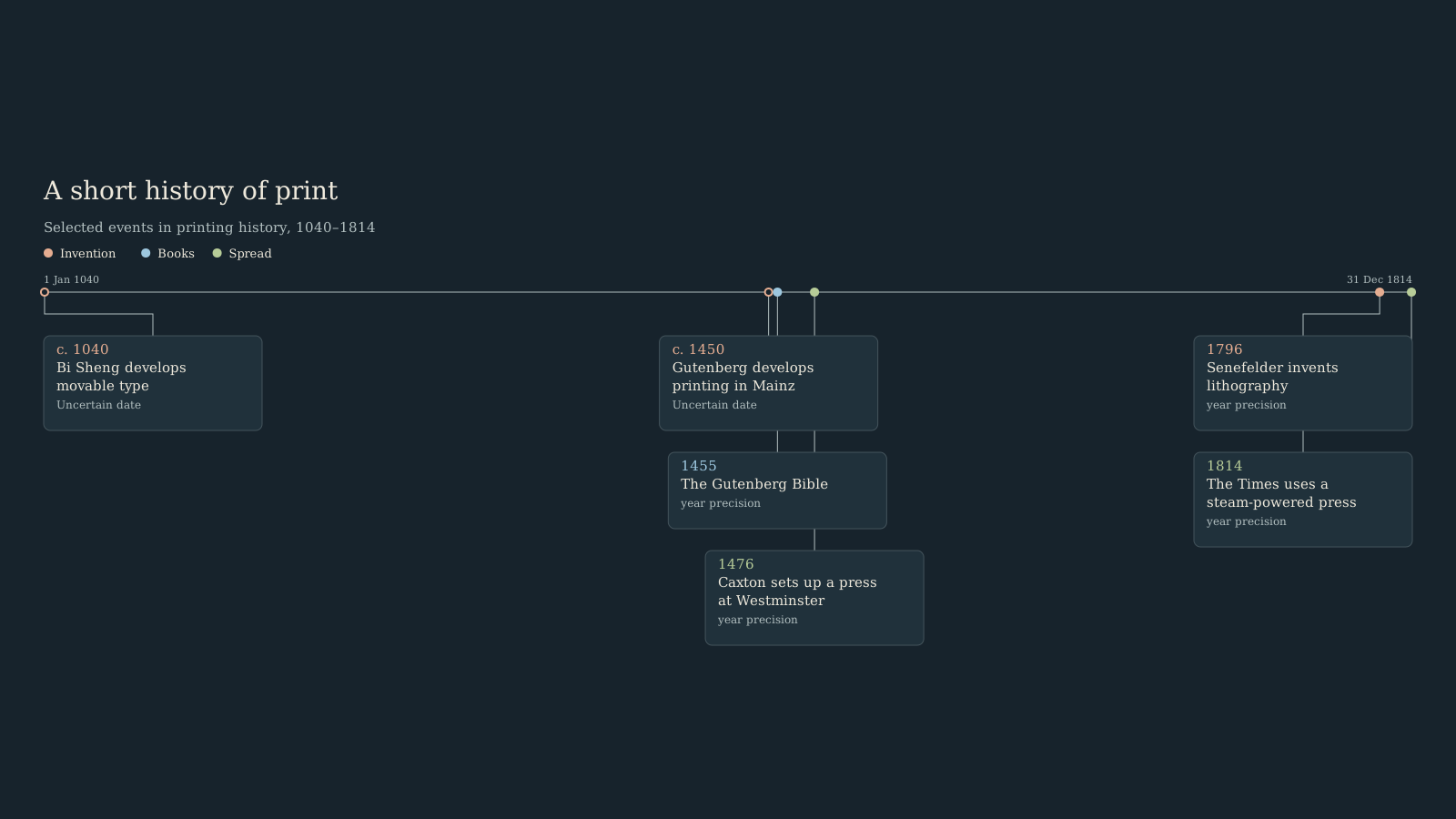
Six events in printing history, 1040–1814. This example uses the Slide layout with the Midnight theme. The SVG retains its text and lines when you resize it.
Sources and scope
This starter contains uncited sample entries. Check the dates against your own references and add citations before using the figure in a publication. Approximate dates retain their original qualifiers.
Compare lives in separate lanes
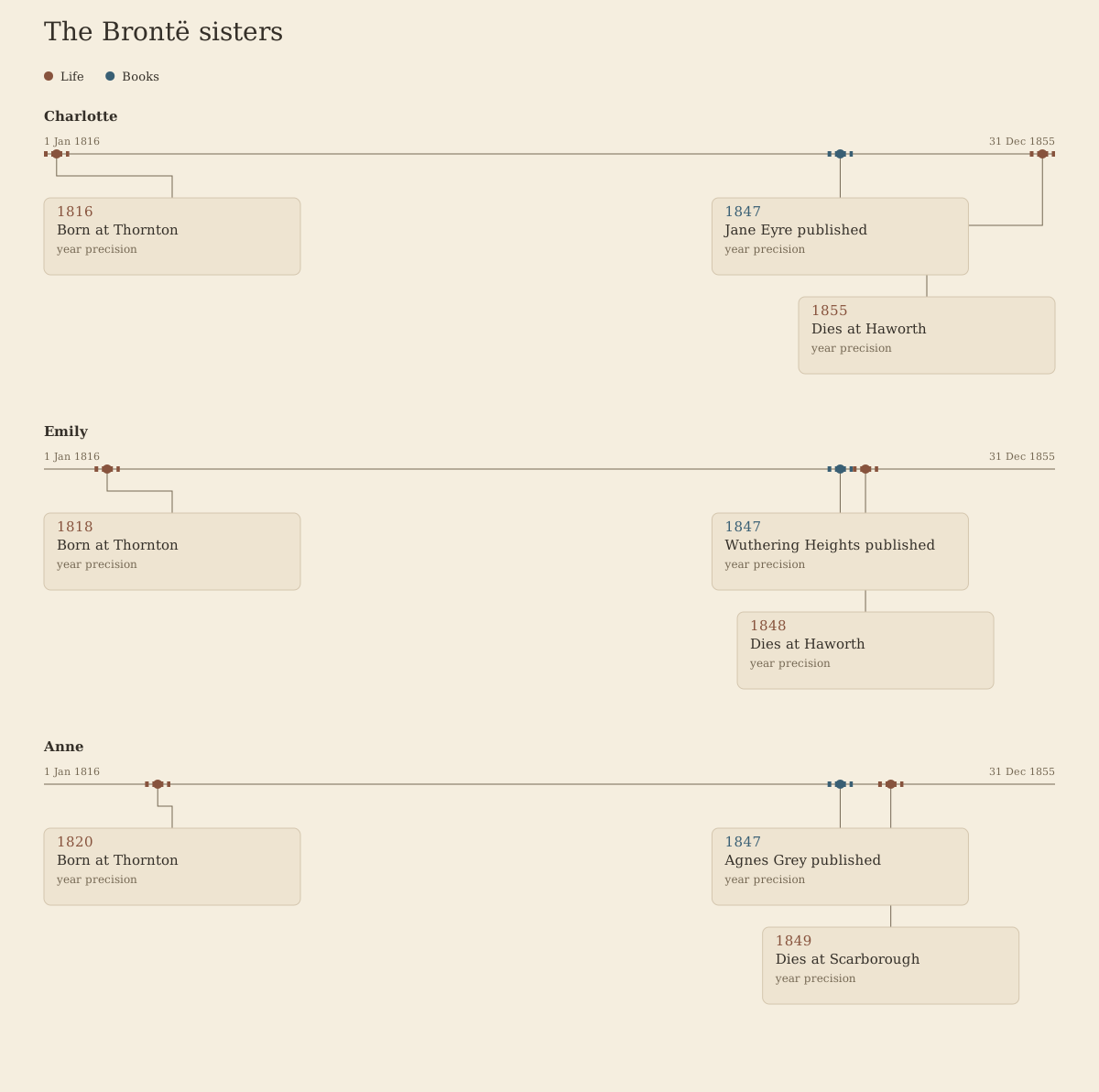
Charlotte, Emily, and Anne Brontë each have a lane. All lanes use the same date scale, so you can compare publication years and life events without changing the chronology.
Sources and scope
This starter contains uncited sample entries. It includes selected births, publications, and deaths, not a complete biography. Add sources to the events before publishing.
Lifespans and first novels
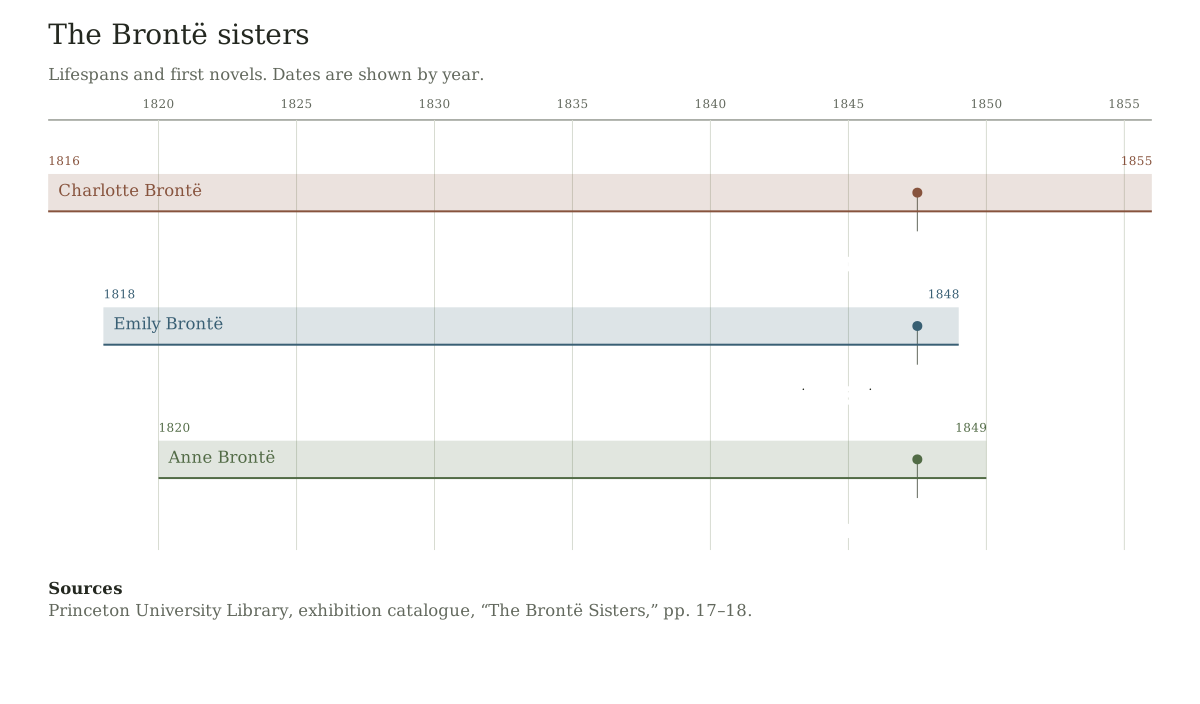
Each bar spans one sister’s life. Publication marks share the same year scale, so you can compare their ages in 1847 and see how much of their lives overlapped.
Scroll the figure sideways, or tap it to open the full-size image.
Sources and scope
Dates follow the Princeton University Library exhibition catalogue, The Brontë Sisters. The figure includes births, deaths, and the first published novels. Dates are shown by year. The 1847 marks show the publication year, not simultaneous publication.
Compare date meanings
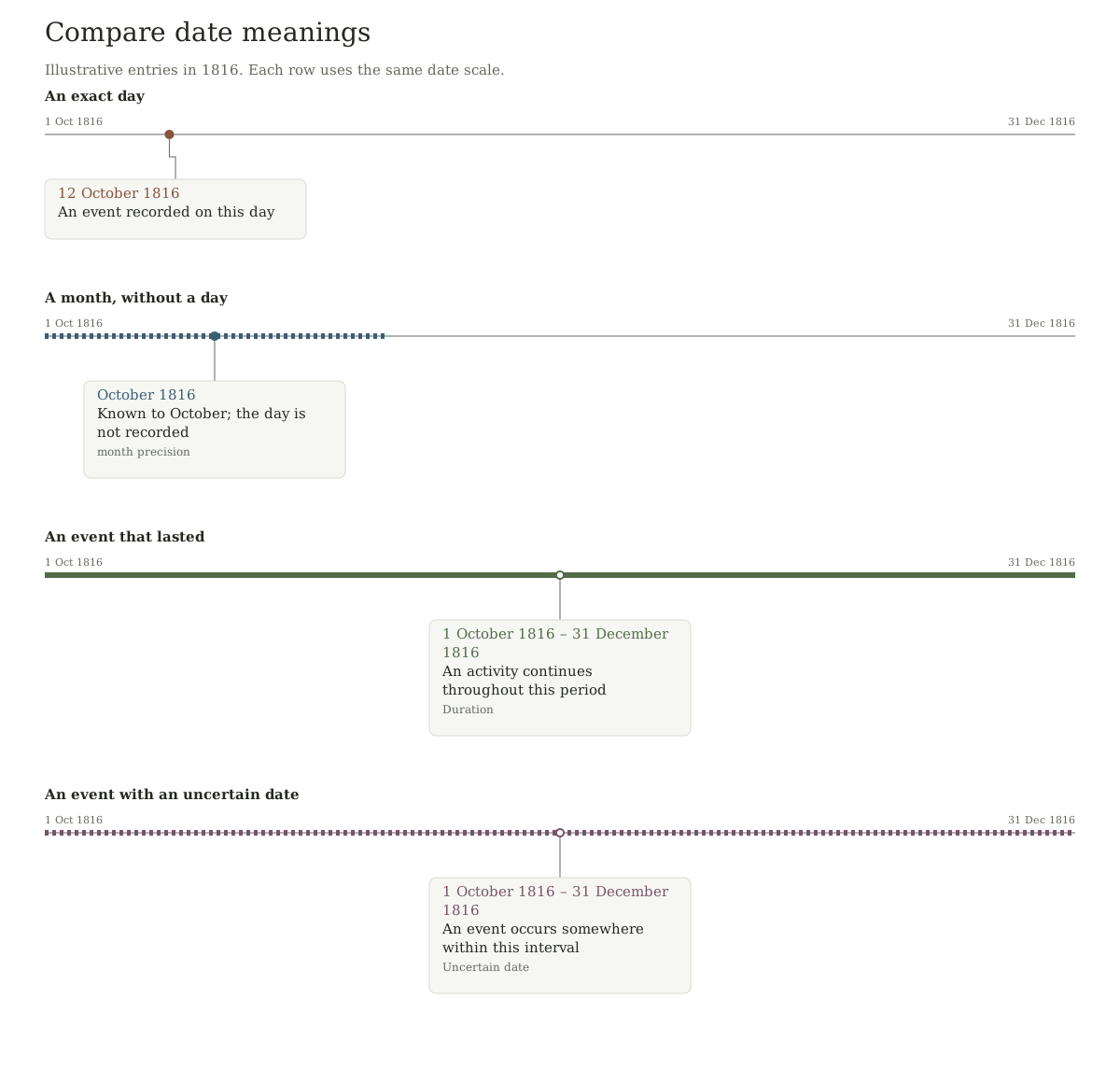
These dates describe different things. These invented entries stay within 1816 and use a shared scale, so you can distinguish a recorded day from a partial date, and an activity’s duration from uncertainty about when an event occurred.
An exact day
12 October 1816 identifies one day. A point marks it.
A month, without a day
October 1816 covers the whole month. The midpoint is a label position, not an asserted event date.
An event that lasted
A solid span shows an activity continuing between the entered start and end dates.
An uncertain date
A dashed span shows the interval in which an event might have occurred. It does not mean the event lasted that long.
BCE/CE, unknown dates, and calendar conventions
1 BCE is followed by 1 CE. There is no public year zero. Unknown dates stay in an unplaced section instead of receiving an invented position. Passages uses a proleptic Gregorian display calendar and does not convert historical calendars. Read the date guide for notation and calendar details.
Export another format
Open a project in Passages and choose Export for PNG or PDF. You can change the layout, drag cards, or save a presentation view before you export; the figure includes visible citations and excludes private notes.